
What Happens During Implant Placement
The first stage of your implant treatment is the dental implant placement. This involves the surgical placement of the implant post into your jawbone. The implant post is a small screw, usually made of titanium or another biocompatible material, which works to replace your tooth root. Once placed, it will function just like your original tooth root to stimulate your supporting jawbone and provide a stable foundation for your teeth and implant restoration. We will provide detailed post-op instructions to help you heal following this procedure.
The Healing Phase and Osseointegration
A period of healing will follow your implant placement procedure. During this healing period, the implant post will integrate with your jawbone to ensure a stable, long-term result for your treatment. This process is known as “osseointegration.” Our dentists will be able to work with you to create and place your implant restoration following this healing period.
Osseointegration simply means that your bone grows around the implant until the two are firmly joined. This is what gives an implant its strength. Healing time varies from patient to patient, and our dentists will tell you what to expect for your own case.
Are You a Good Candidate for Dental Implants?
You may be a good candidate if you:
- Are missing one tooth, several teeth, or all of your teeth
- Have healthy gums, or are willing to treat any gum problems first
- Have enough jawbone, or are open to rebuilding it with a graft
- Are in good general health
- Are committed to brushing, flossing, and regular dental visits
If you have lost supporting bone tissue prior to receiving an implant, you may need a bone grafting treatment before you can have an implant placed. Likewise, any pre-existing conditions, such as tooth decay or gum disease, will need to be treated before you can receive an implant. Our dentists may recommend composite fillings or scaling and root planing as a first step.
Certain factors, such as smoking, diabetes that is not well controlled, and some medications, can affect healing, so tell our team about your health history. We will always be honest about whether implants are a good choice for you.

The Three Parts of a Dental Implant
A complete implant has three components that work together:
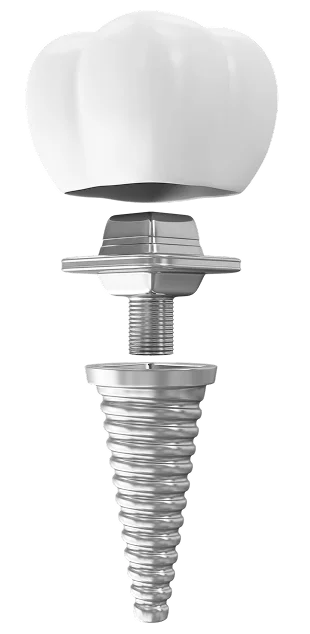
The implant post: the titanium or biocompatible screw placed in your jawbone, which acts as the new tooth root.
The abutment: a small connector that attaches to the post and holds your new tooth in place.
The implant post: the titanium or biocompatible screw placed in your jawbone, which acts as the new tooth root.
Your Implant Journey, From First Scan to Final Smile
Every implant plan is customized, but here is how the process typically unfolds.
01
Consultation and 3D imaging
Our dentists examine your mouth, listen to your goals, and use digital X-rays and cone beam 3D imaging to measure your bone and map the safest position for the implant.
02
Treating any underlying issues
If you have decay, gum disease, or bone loss, we address those first so your implant has the best chance of success.
03
Your personalized plan
We explain the steps, the timeline, and the costs, and answer your questions before anything begins.
04
Comfort during surgery
We numb the area so you feel comfortable. If you feel nervous, ask about nitrous oxide or IV sedation.
05
Placing the implant post
Our dentists place the implant post into your jawbone, precisely and carefully. In some cases, a temporary tooth may be provided while you heal.
06
Healing and osseointegration
Your bone integrates with the implant over the next several months, with follow-up visits to check your progress.
07
Attaching the abutment and restoration
Once the implant is stable, we attach the abutment and create your custom restoration. We will provide detailed post-op instructions along the way.
Why Patients Choose Dental Implants
- Replaces the root: implants stimulate your jawbone the way natural roots do.
- Stable and secure: an implant stays in place when you eat, speak, and laugh.
- Looks and feels natural: the finished restoration is made to match your teeth.
- Does not rely on neighboring teeth: a single implant stands on its own, so adjacent teeth are not reshaped.
- Built to last: with good care, implants are designed to be a long-term solution.
- Helps preserve your facial structure: supporting the bone helps maintain the shape of your smile.
- Easy to care for: you brush and floss around an implant much like a natural tooth.
- Restores your confidence: you can eat the foods you enjoy and smile freely.
Breaking Down the Cost of Dental Implants
Implants are a long-term investment, and the easiest way to understand the cost is to look at it in stages: the consultation and imaging, the placement of the post, any bone grafting, and the final restoration. We will price each stage so you can see exactly where your money goes and decide how to pace your treatment.
Some dental plans contribute to parts of implant care, and others do not, so our team will check what yours offers and handle the claim paperwork. If you would like to divide the cost into monthly payments, ask about financing through Cherry, CareCredit® or Proceed Finance, or pay by cash, check, or credit card.
Ready to Rebuild Your Smile From the Root Up?
For more information about dental implant placement and to schedule your consultation with our dentists, contact our office today.
Our friendly team welcomes patients from Camp Springs. Book a consultation and find out whether dental implants are the right way to restore your smile..
Frequently Asked Questions
About Dental Implant Placement
Dental implant placement is the first stage of implant treatment. It involves the surgical placement of an implant post, a small screw usually made of titanium or another biocompatible material, into your jawbone. The post replaces the root of your missing tooth and provides a stable foundation for your new tooth.
Our team numbs the area, so you should feel pressure but not pain during the procedure. Afterward, some soreness, swelling, or bruising is normal for a few days and can usually be managed with the medication our dentists recommend. If you feel anxious, ask about nitrous oxide or IV sedation.
The total time varies from patient to patient. After the implant is placed, a period of healing follows, during which the post integrates with your jawbone, a process known as osseointegration. Our dentists will then create and place your restoration. If a bone graft or other treatment is needed first, the timeline will be longer. We will explain your own timeline at your consultation
Osseointegration is the process in which your jawbone grows around and bonds with the implant post. It is what makes an implant stable and long-lasting. This healing takes time, and our dentists will check your progress at follow-up visits before attaching your restoration.
Many adults who are missing teeth are candidates, but it depends on the health of your gums, the amount of bone in your jaw, and your general health. Our dentists will examine you, use 3D imaging, and talk through your options. If you have bone loss, a graft may help, and conditions such as decay or gum disease will need to be treated first
Dental implants are designed to be a long-term solution, and with good care and regular dental visits, many last for years. The restoration attached to the implant, such as a crown, may eventually need to be repaired or replaced due to normal wear. Good oral hygiene and avoiding tobacco help protect your implant.
The cost depends on how many implants you need, whether you need a graft, and the type of restoration. Insurance coverage varies, and some plans cover parts of implant care while others do not. Our team will give you a clear breakdown, check your benefits, and discuss financing options such as CareCredit® and Proceed Finance. See our payment options.