
What Is a Dental Implant?
A dental implant is a prosthetic tooth designed to replace your tooth after it has been lost or extracted. Implants are designed to replace both the root and crown of your teeth to give you a solution that looks, feels, and functions just like your original tooth. Implants consist of two main parts: the implant post and the implant restoration.
The implant post is a small, biocompatible post placed in the jawbone, where it acts like a tooth root. The restoration is the visible part, attached to the post, that replaces the tooth above the gumline. Together, they create a stable, long-term replacement for a missing tooth.
Types of Dental Implant Restorations: Crowns, Bridges, and Dentures
After the implant post has been placed and integrated with your jawbone, our dentists will meet with you to discuss your implant restoration. The implant restoration replaces the crown of the missing tooth to complete your treatment. Depending on how many teeth you are missing, this restoration may be a single crown, a dental bridge, or a complete or partial denture. During your consultation, our dentists will determine which type of restoration will provide you with the best results for your oral health, function, and smile.
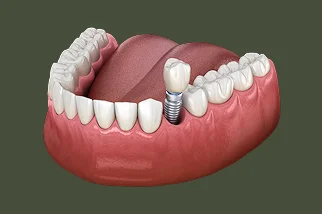
Single-tooth implant crown
A custom porcelain crown attaches to one implant to replace one missing tooth, without involving the neighboring teeth.
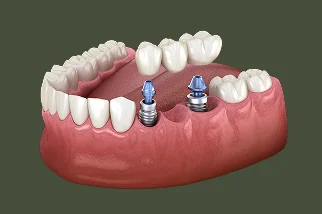
Implant-supported bridge
When several teeth in a row are missing, a bridge can be supported by implants and replace multiple teeth with fewer implant posts.
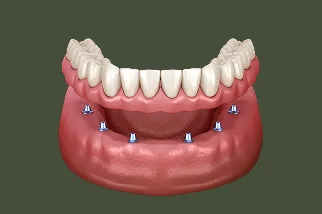
Implant-supported denture
For patients missing many or all of their teeth, a complete or partial denture can attach to implants for added stability. Our office also offers TeethXpress®, which combines features of dentures and dental implants.

From Healed Implant to Finished Smile: How Your Restoration Is Created
Restorations are placed after the implant post has healed and bonded with the jawbone. The exact steps depend on your case, but the process typically looks like this.
01
Consultation and planning
Our dentists review your health history, examine your mouth, and discuss your goals. Imaging helps us plan the best type of restoration for your needs.
02
Implant placement and healing
If you do not have an implant yet, we offer dental implant placement. After placement, the implant needs time to heal and integrate with the jawbone. Healing time varies from patient to patient.
03
Attaching the abutment
Once the implant is stable, a small connector called an abutment is attached to the post. This holds your restoration in place.
04
Taking impressions or digital scans
We capture an accurate impression or digital scan of your mouth so your restoration fits precisely and matches your bite.
05
Custom fabrication and shade matching
Your crown, bridge, or denture is crafted to match the color, shape, and size of your natural teeth. This step often takes place in a dental laboratory and may take a few weeks.
06
Fitting and final adjustments
Our dentists place your restoration, check your bite, and make small adjustments so it feels comfortable and looks natural.
Why Patients Choose Implant-Supported Restorations
- Looks natural: a custom restoration is matched to your surrounding teeth.
- Feels and functions like a real tooth: you can chew, speak, and smile with confidence.
- Restores your bite: replacing missing teeth helps you eat a wider variety of foods.
- Helps protect neighboring teeth: a single implant crown does not rely on adjacent teeth for support, unlike a traditional bridge.
- Supports your jawbone: implants help stimulate the bone, which helps maintain facial structure over time.
- Durable and long-lasting: with good care and regular dental visits, implant restorations are designed to last for years.
- Stable and secure: implant-supported crowns, bridges, and dentures do not slip like some removable options.
Paying for Implant Restorations: Insurance and Financing Options
Replacing a tooth is a meaningful investment, so you should understand the numbers before you commit. Our team reviews your treatment plan with you, explains each part of the cost, and checks what your dental plan may contribute. Coverage for implant-related care differs a great deal from plan to plan, and we are glad to help you sort through the details and file your claim.
If part of the cost falls outside your benefits, you can spread it out with monthly payment options such as Cherry or CareCredit®. Patients without insurance can ask whether the Smile Loft Membership Club fits their needs.
Ready to Smile With Confidence Again?
For more information about dental implant restorations and to schedule an appointment with our experienced dentists, contact our office today.
Our friendly team welcomes patients from Camp Springs, Largo, Bowie, Lanham, DC, and Virginia. Schedule a consultation and learn which restoration is right for you.
Frequently Asked Questions
About Dental Implant Restorations
A dental implant restoration is the visible part of a dental implant that replaces the crown of a missing tooth. It attaches to the implant post in your jawbone and may be a single crown, a bridge, or a partial or complete denture, depending on how many teeth you are missing. It completes your implant treatment and restores the look and function of your smile.
The main types are single crowns, implant-supported bridges, and implant-supported dentures, either partial or complete. A crown replaces one tooth, a bridge replaces several teeth in a row, and a denture replaces many or all teeth. Our dentists will recommend the best option for your oral health, function, and smile.
The implant needs time to heal and bond with the jawbone before the final restoration is attached. Healing time varies from patient to patient, and our dentists will tell you what to expect for your case. In some cases, a temporary restoration may be used while you heal.
Most patients find this stage comfortable, because the restoration is placed on top of an implant that has already healed. Our team uses local anesthetic if needed, and you may feel pressure but not pain. If you feel anxious, ask about nitrous oxide or IV sedation.
Implant restorations are designed to be durable and long-lasting, and many last for years with good care. Their lifespan depends on your oral hygiene, your habits, and your regular dental visits. Crowns and other restorations may eventually wear and need to be replaced, even when the implant post itself remains stable.
Yes. Each restoration is custom-designed to match the color, shape, and size of your natural teeth so it blends in with your smile. Our dentists also check your bite to make sure the restoration feels comfortable and works naturally when you chew and speak.
Care for it like a natural tooth. Brush twice a day, floss daily, and visit our office for regular cleanings and exams. Avoid chewing very hard items, avoid tobacco, and wear a night guard if you grind your teeth. Good care helps protect the gums and bone that support your implant.
Coverage varies widely. Many dental insurance plans help cover part of implant treatment or the restoration, while others do not cover implants. We work with most major dental insurance plans, and our team can help you review your benefits before treatment. If you do not have insurance, ask about the Smile Loft Membership Club or our financing options.